
Preventive Dentistry
Dental Exams & X-Rays in Gladstone
See what’s happening beneath the surface.
A careful exam and the right images give your dentist a clear picture of your oral health. That picture is the starting point for every recommendation we make.

Exceptional Dentistry in Gladstone, MO
Why a dental exam matters
Many dental problems grow quietly, without pain or any sign you would notice in the mirror. A routine exam is the chance to catch them while they are small, when treatment is usually simpler. During the visit your dentist looks closely at each tooth, checks your gums and bite, and examines the soft tissues of your mouth. X-rays add the part of the story the eye cannot see, such as decay between teeth, the health of the bone around the roots and teeth that have not yet come in. Together, the exam and images let your dentist explain what they found and talk through any next steps with you.
What we look at
More than a quick look at your teeth
-
Teeth and restorations
Signs of decay, cracks and wear, plus a check of existing fillings and Dental Crowns.
-
Gums and supporting bone
Gum health is measured and compared over time, since early gum disease often has no symptoms.
-
Bite and jaw
How your teeth meet, and whether the jaw joints show signs of strain or grinding.
-
Soft tissues
The tongue, cheeks, lips and throat, including an oral cancer screening.
The imaging we use
Your dentist chooses images based on what needs to be seen. Digital X-rays appear on screen within moments, so you can look at them together. A panoramic X-ray shows the whole upper and lower jaw in one view, and an intraoral camera lets you see close-up pictures of your own teeth. When a more detailed view of bone or roots is needed, a cone beam CT scan, which builds a three-dimensional image, may be recommended.
What to expect
How your exam visit usually goes
- We review your health history, medications and any concerns you have noticed
- X-rays are taken if your dentist decides they are needed for this visit
- Your dentist examines your teeth, gums, bite and soft tissues
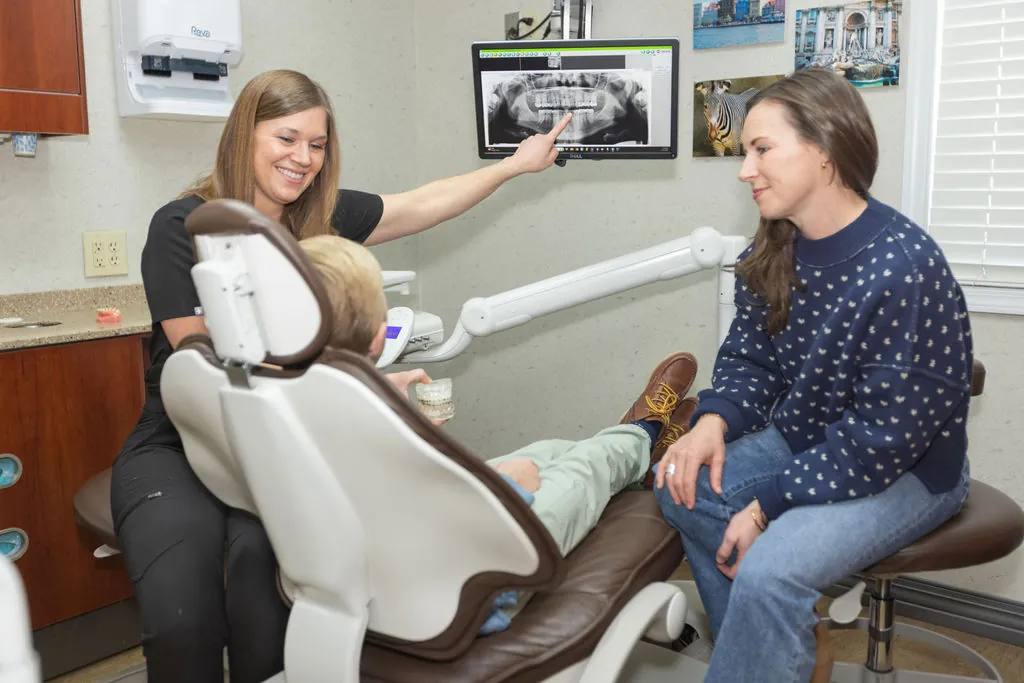
- Findings are explained in plain language, with images on screen
- You leave knowing what, if anything, needs attention and what your options are
New patient special
$98
A $308 value for your first visit
Visiting us for the first time? Our new patient offer includes:
- Comprehensive exam
- Panoramic X-rays
- Bitewing digital X-rays
- Intraoral photos
- Smile evaluation
- Full gum evaluation
- Oral cancer screening
- TMJ and bite evaluation
- Review of your treatment options
- A written treatment plan
Why choose Marx Family Dental for your exam?
We take the time to show you what we see rather than just telling you. Exams are usually paired with a professional cleaning, and they are the foundation of our general dentistry care for the whole family.
Book your visit
Book your exam and X-rays
If it has been a while since your last checkup, now is a good time to get a clear picture of your oral health. Book online or give our team a call.
The short answer
A dental exam is a careful check of your teeth, gums, bite and the soft tissues of your mouth, usually paired with X-rays that show what the eye cannot see. Your dentist reviews your health history, looks for decay, cracks and wear, measures gum health, checks how your teeth and jaw meet, and screens the tongue, cheeks, lips and throat. Because many dental problems grow quietly without pain, a routine exam is the chance to find them while they are small and treatment is usually simpler.
Exam & X-Rays FAQ
- Do I need X-rays at every visit?
- Not necessarily, because your dentist decides which images are needed at each visit. That choice is based on your health history, your risk of decay and what they find during the exam. Some visits call for new images to check a specific concern, while others may not need any. Your dentist will explain why an image is being recommended before it is taken.
- Are dental X-rays safe?
- Dental X-rays use a low level of radiation, and your dentist only recommends them when the information they provide is useful for your care. Digital X-rays appear on screen within moments, so you can look at the images together with your dentist. If you are pregnant or may be, let us know before any images are taken. Your dentist can then decide whether an X-ray is needed now or can wait.
- What can an X-ray show that an exam cannot?
- X-rays can reveal decay between teeth or under fillings, bone loss around the roots, infections, impacted teeth and developing teeth in children. These problems sit below the gumline or between teeth, where they cannot be seen by eye. Finding them on an image lets your dentist catch them while they are small, when treatment is usually simpler. When a more detailed view of bone or roots is needed, a cone beam CT scan may be recommended.
- What is the difference between bitewing and panoramic X-rays?
- Bitewings are close-up images of the back teeth, while a panoramic X-ray captures both the upper and lower jaw in a single wide image. Bitewings are often used to find decay between the back teeth, where it is hard to spot during an exam. A panoramic view shows the whole jaw at once, including teeth that have not yet come in. Your dentist chooses between them based on what needs to be seen.
- How often should I have a dental exam?
- How often you need a dental exam depends on your oral health. Your dentist will recommend a schedule that fits your needs, based on what they find and how your teeth and gums change over time. Because early gum disease and small cavities often have no symptoms, regular exams help catch them before they grow. Exams are usually paired with a professional cleaning, so both are taken care of at the same visit.
Your dentist
Meet Dr. Emily Marx
A skilled family dentist, Dr. Marx is passionate about helping patients feel comfortable while achieving their best smile. Meet Dr. Marx